Local Species Database

Identify local reptiles, learn about their behavior, and understand their role in our ecosystem.

View details for Andaman Pit Viper
Andaman Pit Viper
Mildly Venomous

Trimeresurus andamanensis

Andaman Pit Viper

The Andaman Pit Viper is an island endemic species found exclusively in the Andaman and Nicobar Islands of India. This arboreal pit viper displays beautiful green coloring, sometimes with blue or yellow variations. Its hemotoxic venom causes local symptoms including pain, swelling, and potential tissue necrosis. While medically significant, fatalities are extremely rare. The isolated island population makes it an important species for conservation. This nocturnal species inhabits the dense tropical evergreen forests of the Andaman Islands. It feeds on frogs, lizards, small birds, and rodents. Due to its restricted island habitat, any deforestation or habitat loss poses a significant threat to its survival.
Endemic to the Andam...
Read More
View details for Bamboo Pit Viper
Bamboo Pit Viper
Mildly Venomous

Trimeresurus gramineus

Bamboo Pit Viper

The Bamboo Pit Viper is a strikingly beautiful arboreal snake with a vivid bright green body and distinctive yellow eyes. Also known as the Indian Green Pit Viper, it is commonly found in the hill forests of peninsular India. This species has mildly hemotoxic venom that causes local pain, swelling, and bleeding at the bite site. While bites are painful, they are rarely fatal to humans. The venom primarily aids in subduing small prey like frogs, lizards, and birds. Bamboo Pit Vipers are nocturnal and spend most of their time coiled on tree branches, especially bamboo, where their green coloring provides perfect camouflage. They have a prehensile tail that helps them grip branches. The species gives birth to live young (4-11 per litter).
Found in the Western...
Read More
View details for Beddome's Cat Snake
Beddome's Cat Snake
Mildly Venomous

Boiga beddomei

Beddome's Cat Snake

The Beddome's Cat Snake is a slender, arboreal, rear-fanged snake endemic to the Western Ghats of India. Named after Colonel Richard Henry Beddome, a British army officer and naturalist, this species is an important component of the Western Ghats biodiversity. Like other cat snakes, it has mildly venomous rear fangs that pose minimal risk to humans. The venom is primarily used to subdue prey such as geckos, frogs, and small lizards. Bites may cause mild local symptoms but are not medically significant. This nocturnal snake is an excellent climber found in the evergreen and semi-evergreen forests of the Western Ghats. Its brown body with dark crossbands provides camouflage against tree bark. The species plays an important role in controlling gecko and lizard populations in its forest habitat.
Endemic to the Weste...
Read More
View details for Common Cat Snake
Common Cat Snake
Mildly Venomous

Boiga trigonata

Common Cat Snake

The Common Cat Snake is a slender, nocturnal, rear-fanged snake named for its distinctive vertically elliptical pupils resembling cat eyes. It is one of the most commonly encountered mildly venomous snakes in India. This snake possesses mild venom delivered through rear fangs (opisthoglyphous). While the venom can cause localized pain and swelling, it is not considered dangerous to humans. The venom primarily aids in subduing prey such as geckos, lizards, and small frogs. Cat Snakes are excellent climbers and are often found in trees, bushes, and on walls of homes where they hunt geckos. They are docile but may flatten their body and strike when threatened. The triangular head shape often causes them to be mistaken for vipers, leading to unnecessary killing.
Found throughout Ind...
Read More
View details for Himalayan Pit Viper
Himalayan Pit Viper
Mildly Venomous

Gloydius himalayanus

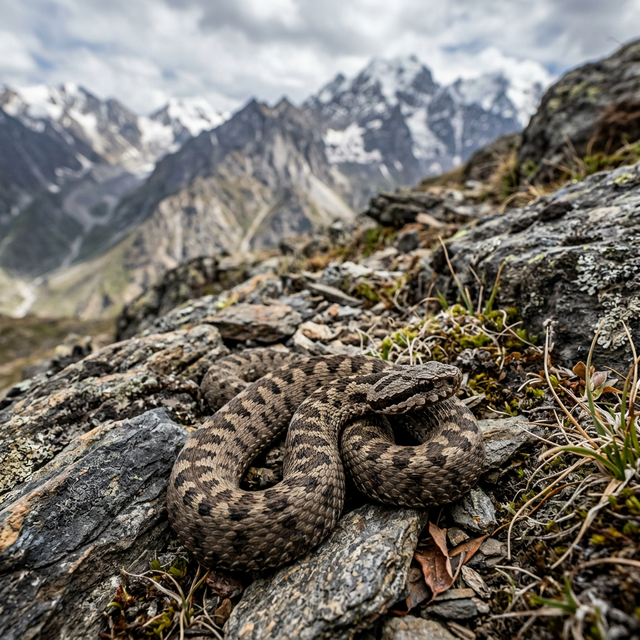
Himalayan Pit Viper

The Himalayan Pit Viper is a high-altitude pit viper found across the Himalayan mountain ranges of India. It is one of the few venomous snakes adapted to cold mountain environments, surviving at elevations up to 4,900 meters. This relatively small snake (40-70 cm) has mildly hemotoxic venom that causes localized pain and swelling. While bites are painful, they are rarely life-threatening. The snake is generally sluggish and non-aggressive. Himalayan Pit Vipers are important predators in their ecosystem, feeding on mice, lizards, and small birds. They are viviparous, giving birth to 4-10 live young. Their brownish-grey coloring with dark zigzag patterns provides excellent camouflage against the rocky mountain terrain.
Found across the Him...
Read More
View details for White-lipped Pit Viper
White-lipped Pit Viper
Mildly Venomous

Trimeresurus albolabris

White-lipped Pit Viper

The White-lipped Pit Viper is a beautiful bright green pit viper with a distinctive white or pale yellow stripe along the lower lip. Males may also display a white and red-brown stripe along the body. This arboreal viper is found in Northeast India. Its hemotoxic venom causes pain, swelling, and bruising. While bites can be serious and require medical attention, fatalities are uncommon. The venom primarily serves to immobilize small prey. White-lipped Pit Vipers are nocturnal hunters that ambush prey from tree branches. They feed on frogs, lizards, small birds, and rodents. The species is ovoviviparous, with females giving birth to 6-11 live young. Their bright green coloration provides excellent camouflage in the lush forests of Northeast India.
Found in Northeast I...
Read More
Chat with us